Molly Haskell on Feminism and Film: Fashion Historian's Perspective
This was originally posted to my Substack.
Yesterday, I released a new episode of the Sighs and Whispers podcast—a conversation with movie critic and author Molly Haskell. Below is an introduction to Molly—you can listen to our discussion on Soundcloud, Apple Podcasts, and Spotify.
Before anything else, read Margaret Killjoy’s documentation of her time in Minneapolis last week. Everything is really intense right now, but her words about the strength of the communities and the networks there seem to point a way forward, together:
But the thing is, what’s happening in Minneapolis is happening elsewhere too, and has been happening for some time now. People are being kidnapped and disappeared. People are dying in custody and people are dying on the streets. Police are killing people, ICE are killing people.
And at least as importantly, people are trying to stop it. And it’s not just a bunch of die-hard activists, nor just the families of the people most affected.
What works to stop fascism, the Twin Cities is showing us, is when everyone steps up. When everyone feels empowered, even if it’s just to blow a whistle or honk a horn or yell in the snow in slippers. When everyone understands that the work of making the world better is the work of taking responsibility for one another.
When everyone understands that we are, all of us, neighbors.
At the end of Killjoy’s piece is a list of personally vetted local Minneapolis fundraisers to which you can donate. Stand with Minnesota is also a comprehensive database of places to donate.
The Museum of the Moving Image recently described Molly Haskell as a “legendary film critic… whose writing on women in film in the 1970s set the template for decades of feminist film criticism.” Her first book, From Reverence to Rape: The Treatment of Women in the Movies, was published in 1973 and fundamentally changed the way we look at women in film. Although later feminist film critics considered Molly’s work too heterosexually focused, with this one book, she essentially laid the groundwork for the entire field of feminist film theory and criticism.
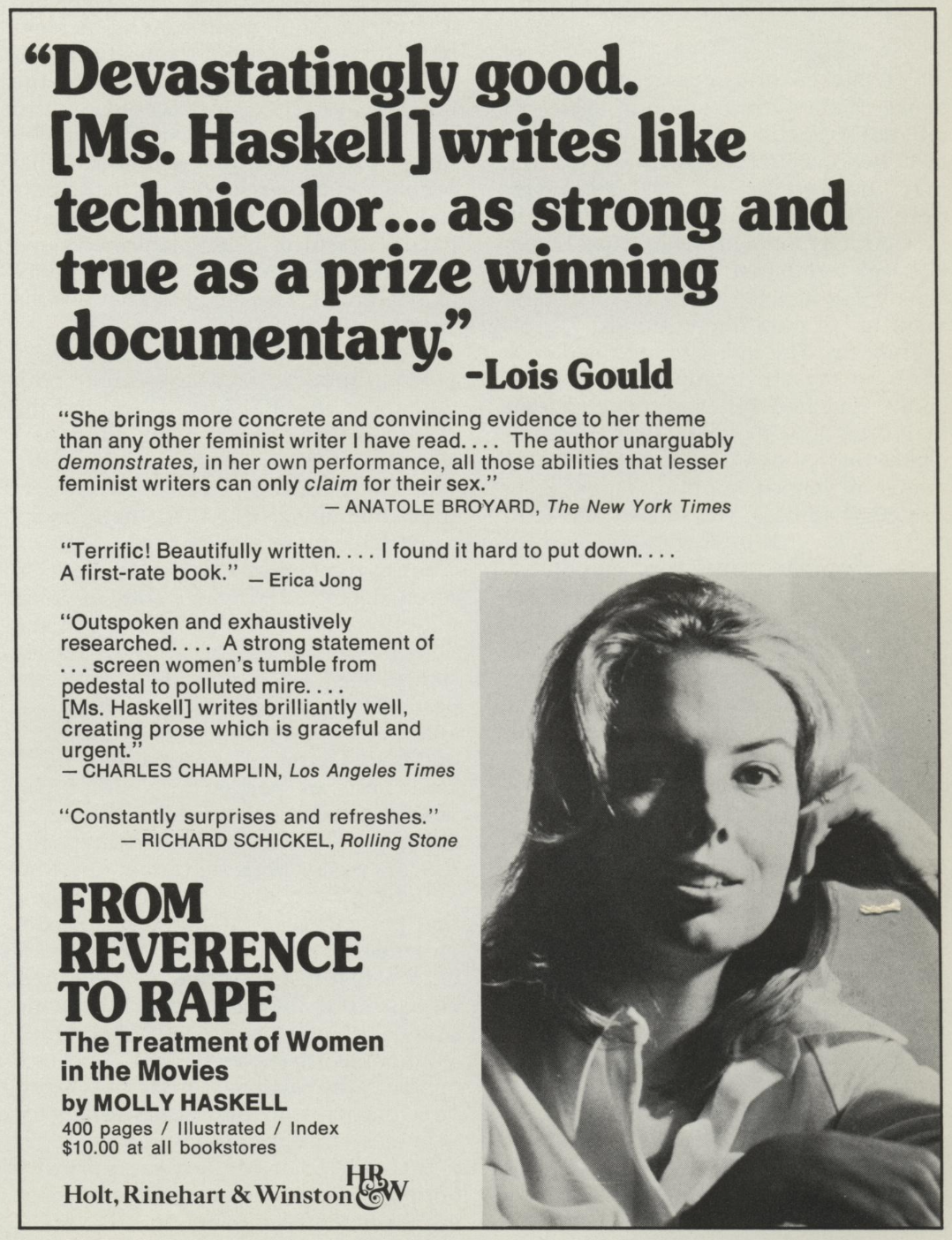
An ad published in Film Comment, July/August 1974.
This was quite a heady change from her well-bred southern childhood in Richmond, Virginia, where she was a debutante. I find the dichotomy between her “Southern Belle” (to use her own phrasing) upbringing and her New York cinema-saturated adulthood fascinating—one about propriety, decorum, and tradition, the other revolving around curiosity, openness, and multiculturalism. How she went from a rather repressive society—with a very narrow understanding of women’s possibilities in life—to a world of revival screenings, film festivals, and deep philosophical conversations about cinema as art… Now, that is a story. In her books, Molly drops little nuggets about her upbringing and background—tantalizing crumbs amidst discussions of Barbara Stanwyck or Joan Crawford.
Wanting to learn more, I approached Molly, and we spoke for the podcast earlier this month. As she details in our conversation, she escaped to Paris in the early 1960s, where she discovered French cinema and the nascent Nouvelle Vague. Back in New York, Molly lived a very Mad Man-esque life for a few years as a secretary before getting a job at the French Film Office, writing press releases about French films and translating for visiting directors. While working there, she met the film critic for The Village Voice, Andrew Sarris. Together they embarked on a cinematic love story that would last 43 years, until his death in 2012. At the time they met, Sarris was popularizing the auteur theory and redefining movie criticism, alongside and often in opposition to Pauline Kael.
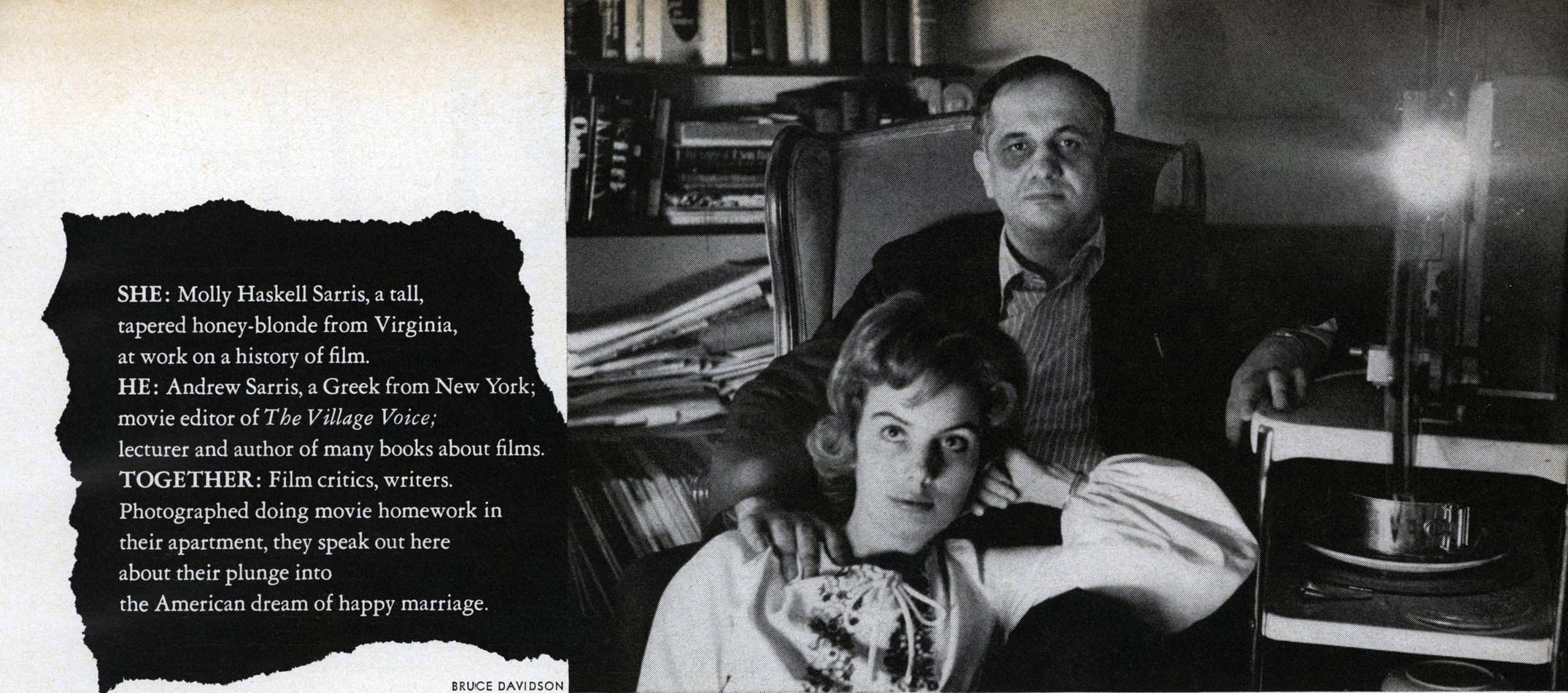
Molly Haskell and Andrew Sarris at home in Manhattan. Photo by Bruce Davidson for Vogue, June 1971.
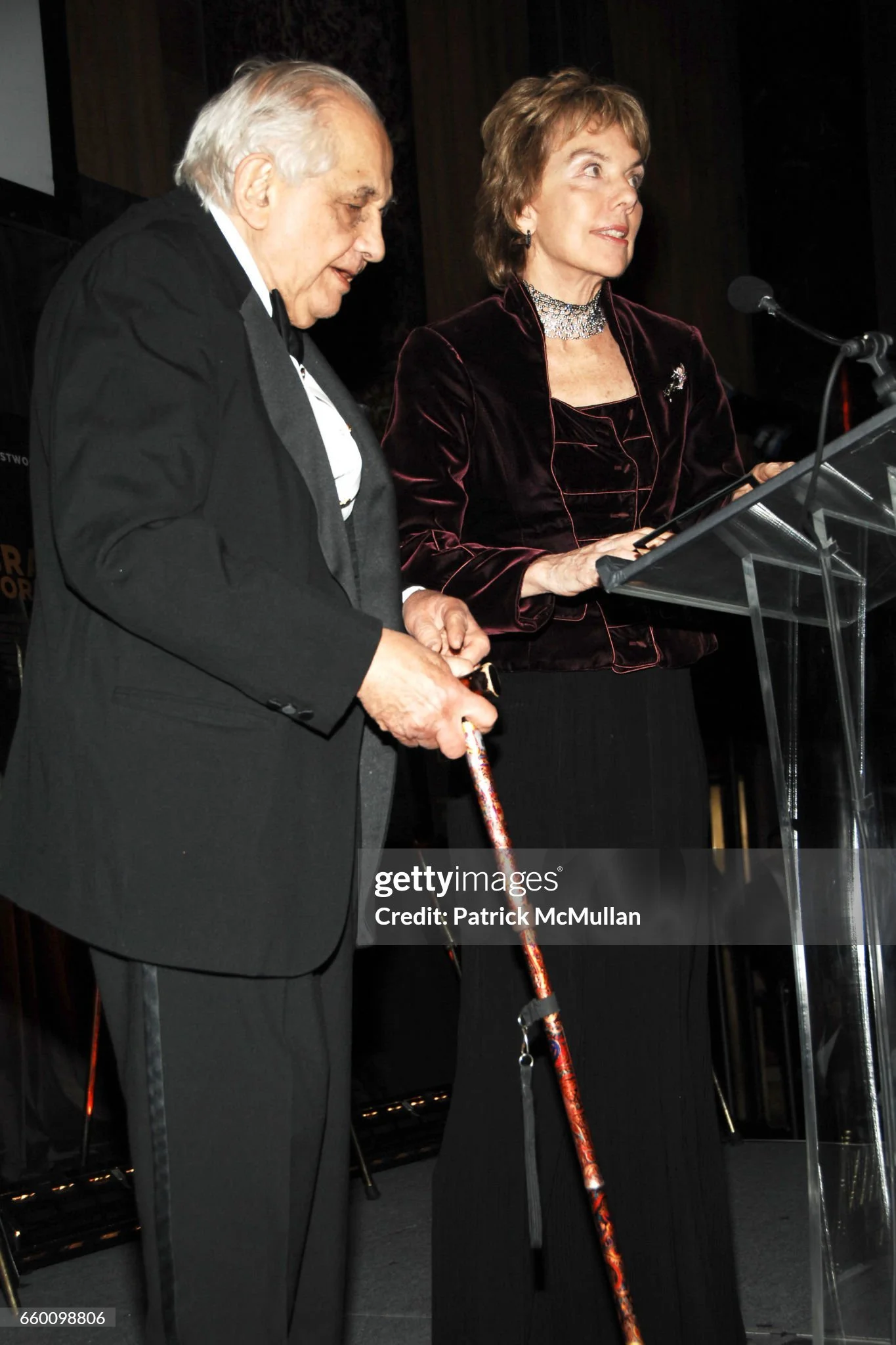
Andrew Sarris and Molly Haskell at the 2008 National Board of Review Awards, hosted by BVLGARI at Cipriani 42nd Street on January 14, 2009, in New York City. Photo by PATRICK MCMULLAN/GETTY.
In 1969, Haskell joined The Village Voice, first as a theater critic, then as a movie reviewer; and after their marriage, she went on to write in the 1970s and 1980s for New York Magazine, Vogue, Ms., and Viva. I first became aware of Molly’s writing through Viva, where her feminist film criticism fit easily within the heady liberatory politics of the magazine. Additionally, she has written for The New York Times, The Guardian, Esquire, The New York Review of Books, Film Comment, and many other publications.
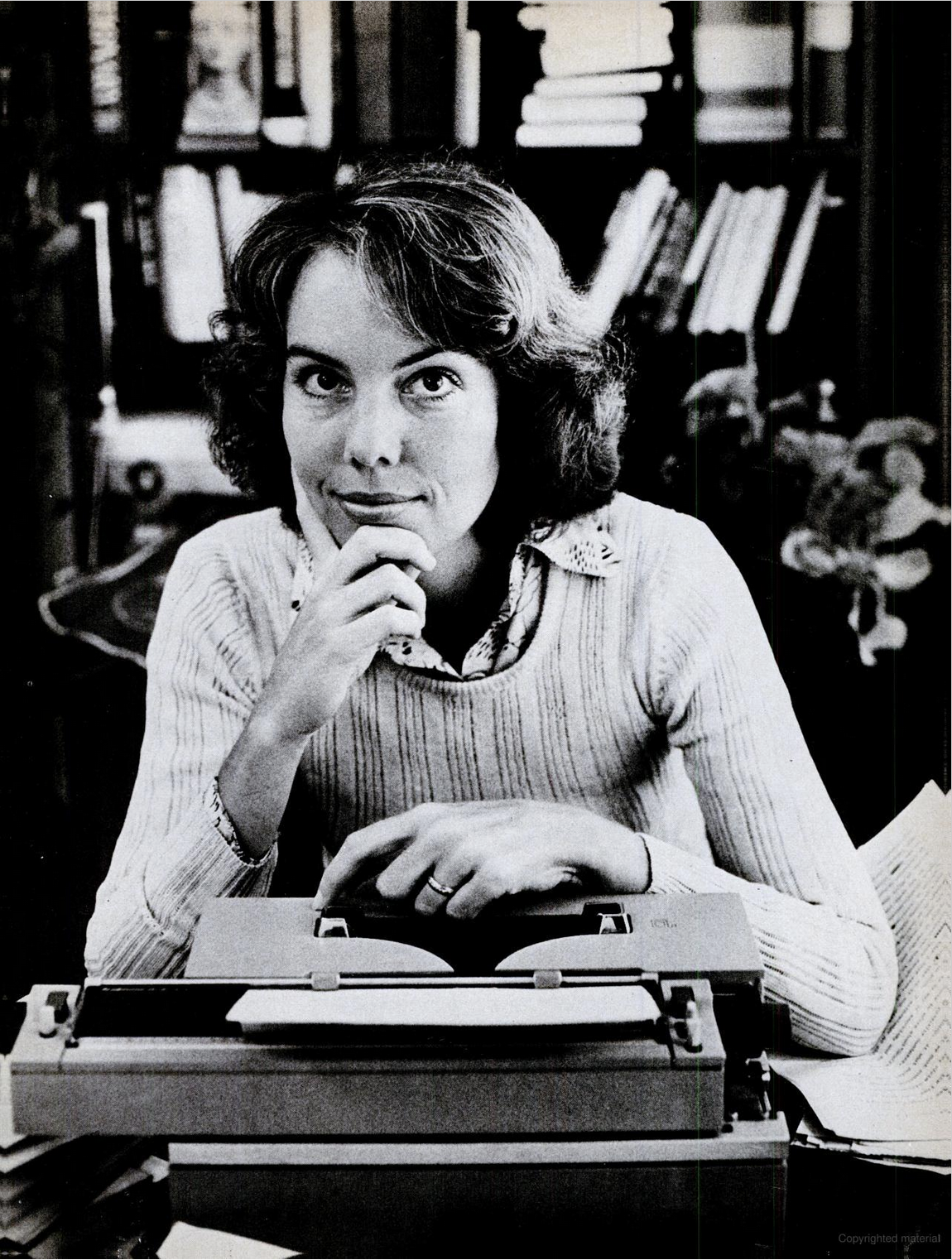
Molly Haskell at home. Photo by Dan Wynn for New York, March 29, 1976. This portrait ran as a full page in the story below.
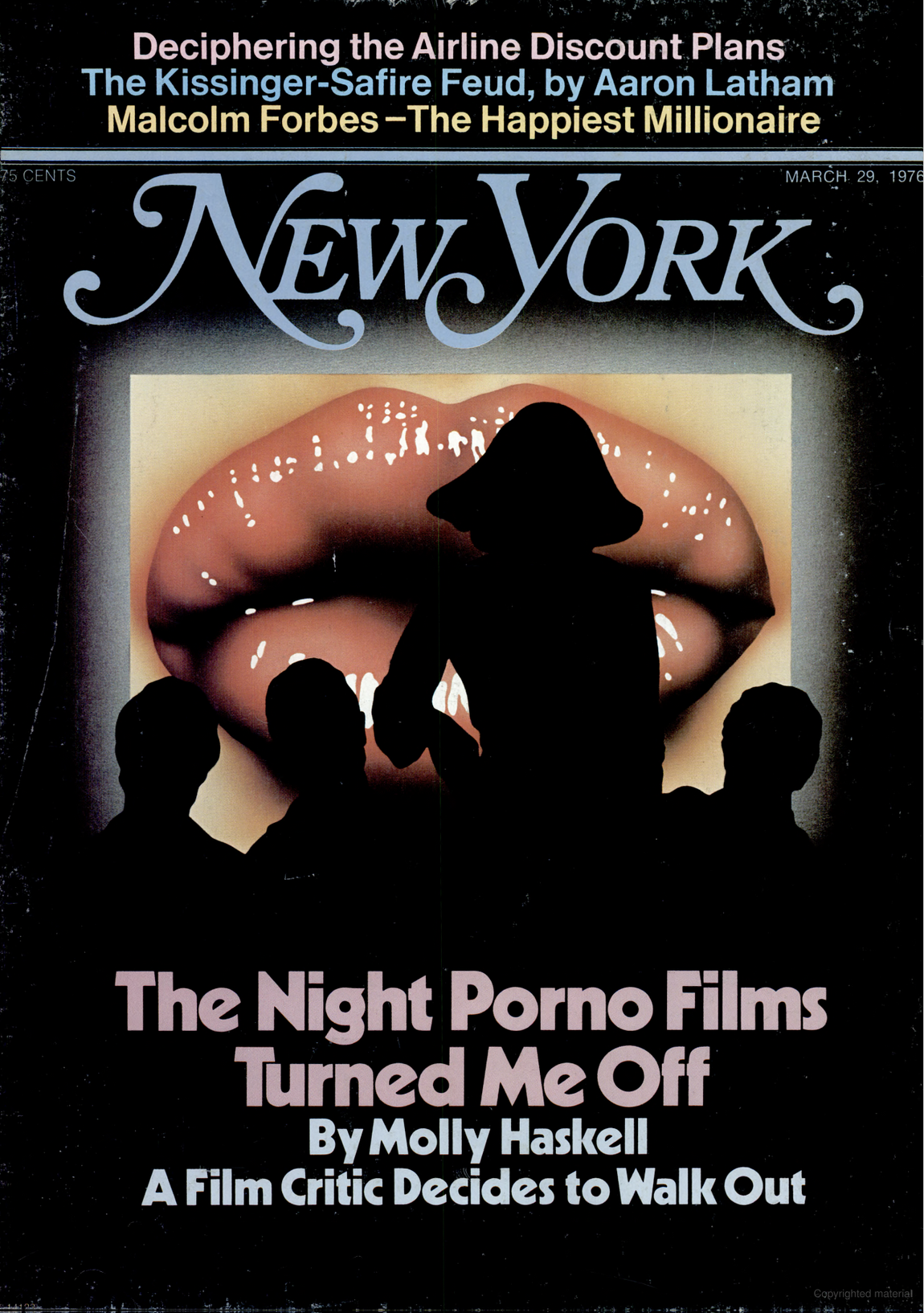
Molly Haskell’s essay on porn covers New York, March 29, 1976. Illustration by Nicholas Gaetano.
In addition to From Reverence to Rape, she is the author of a memoir, Love and Other Infectious Diseases, which details a mysterious illness that almost killed Andrew in the early 1980s; a collection of essays and interviews called Holding My Own in No Man’s Land: Women and Men and Films and Feminists; a book about Gone with the Wind, Frankly, My Dear; and a book about her sibling coming out as transgender, My Brother, My Sister; as well as a biography, Steven Spielberg: A Life in Films.
At 86 years old, Molly still lives on Manhattan’s Upper East Side, still constantly watching films and writing about them. She has been working on a memoir of her life, going into greater detail about that decision to forgo the life of a housewife, instead choosing a career and a marriage built on a shared passion for film (if you work at a publisher, buy this book!) Of course, we spoke about movies, but also about growing up in the South in the 1940s and 50s, feminism, the life of a writer and critic, and so much more.
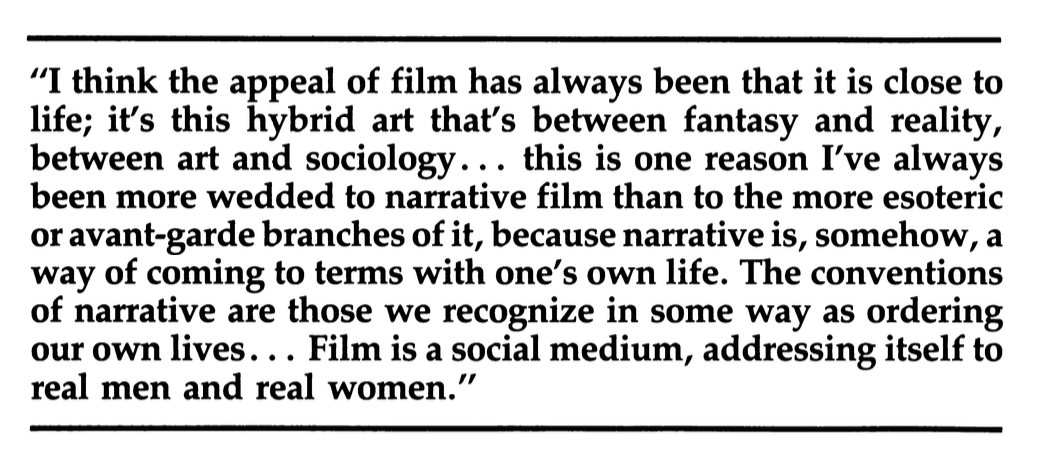
From an interview Molly gave to Gary Crowdus and Melanie Wallace, Cineaste Vol. 11, Iss. 3 (1981):
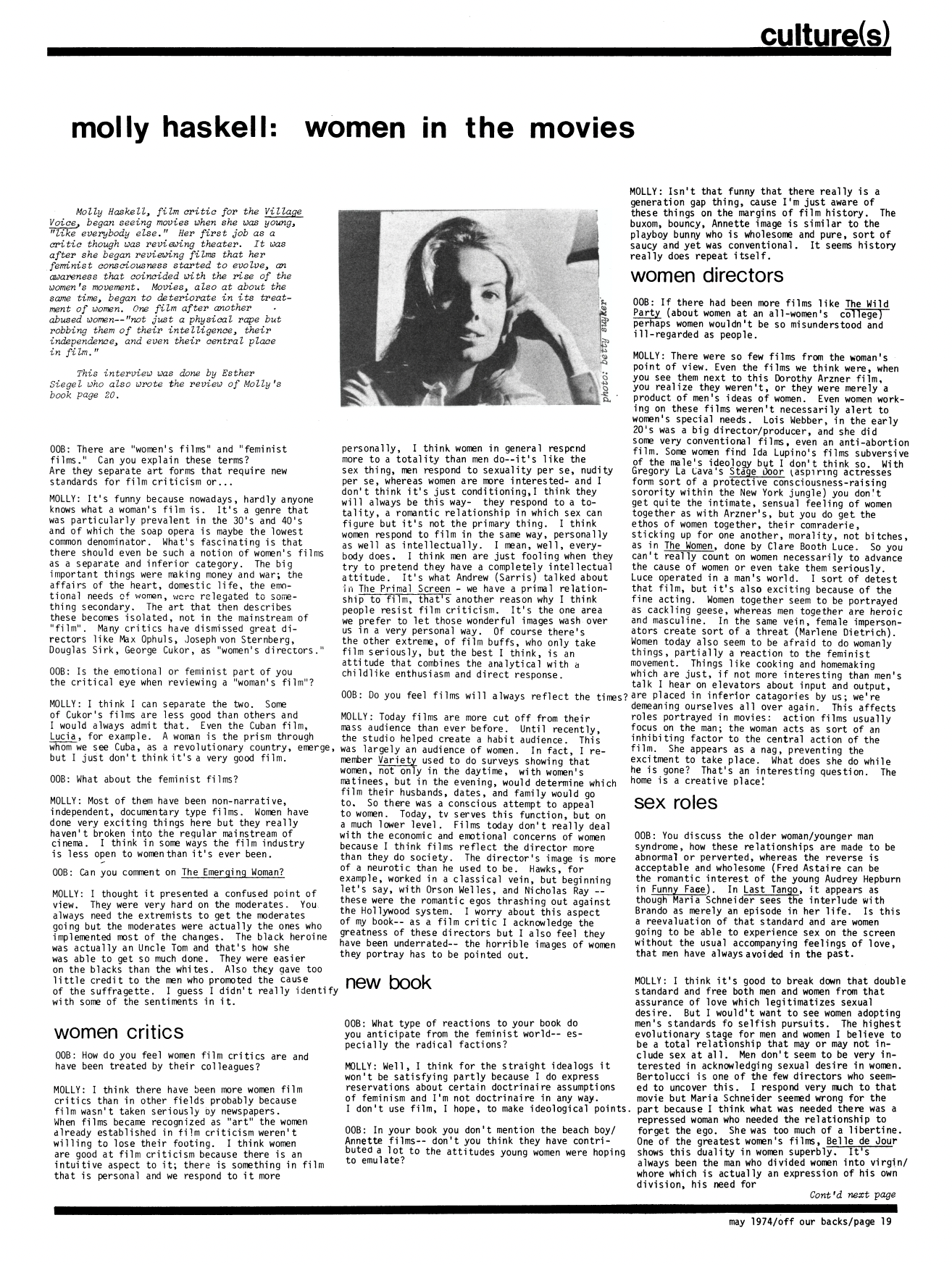
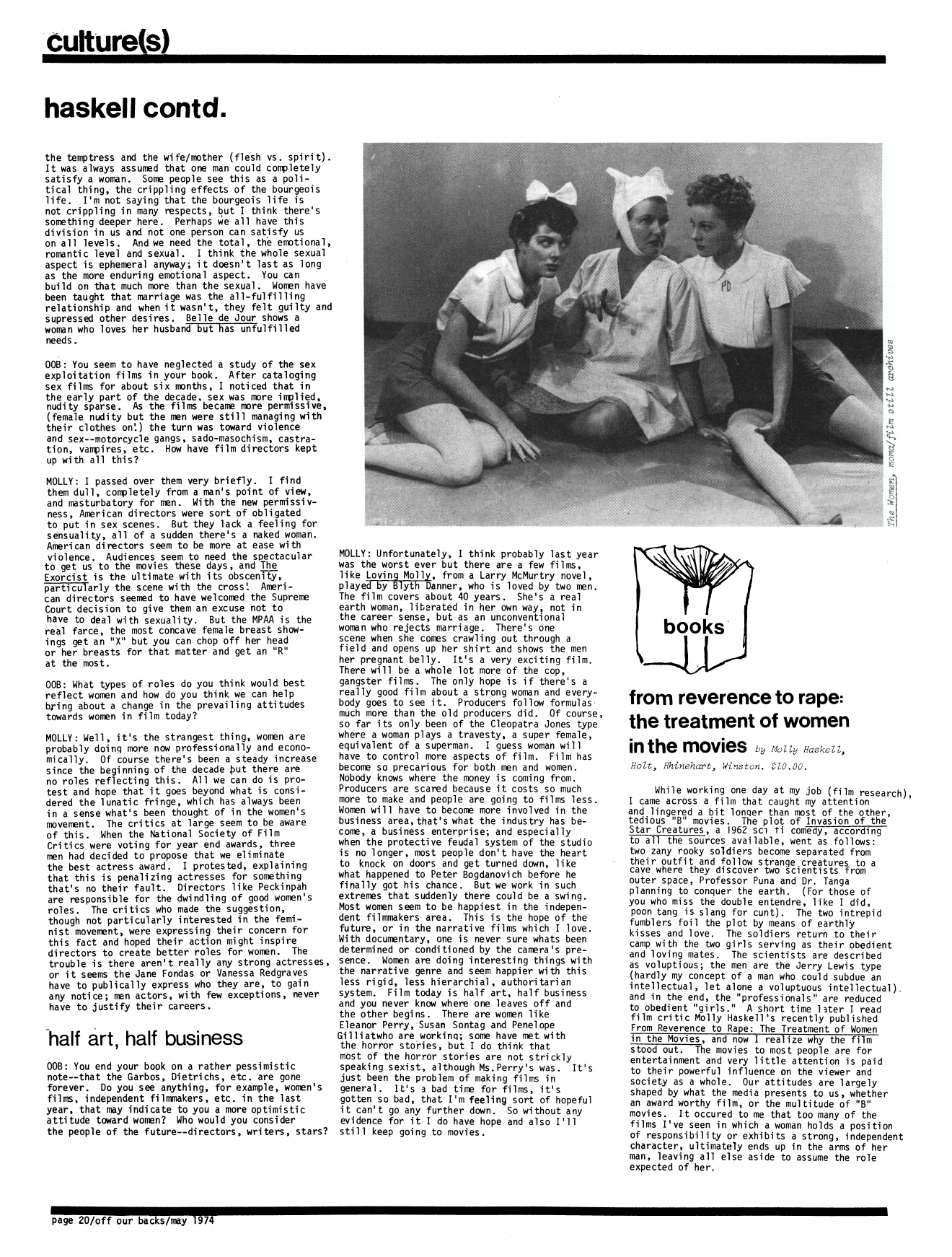
An interview with Molly from the radical feminist periodical Off Our Backs, May 1974:
Laura McLaws Helms is a fashion and cultural historian available for consulting on film, television, publishing, and brand projects. Contact her here.